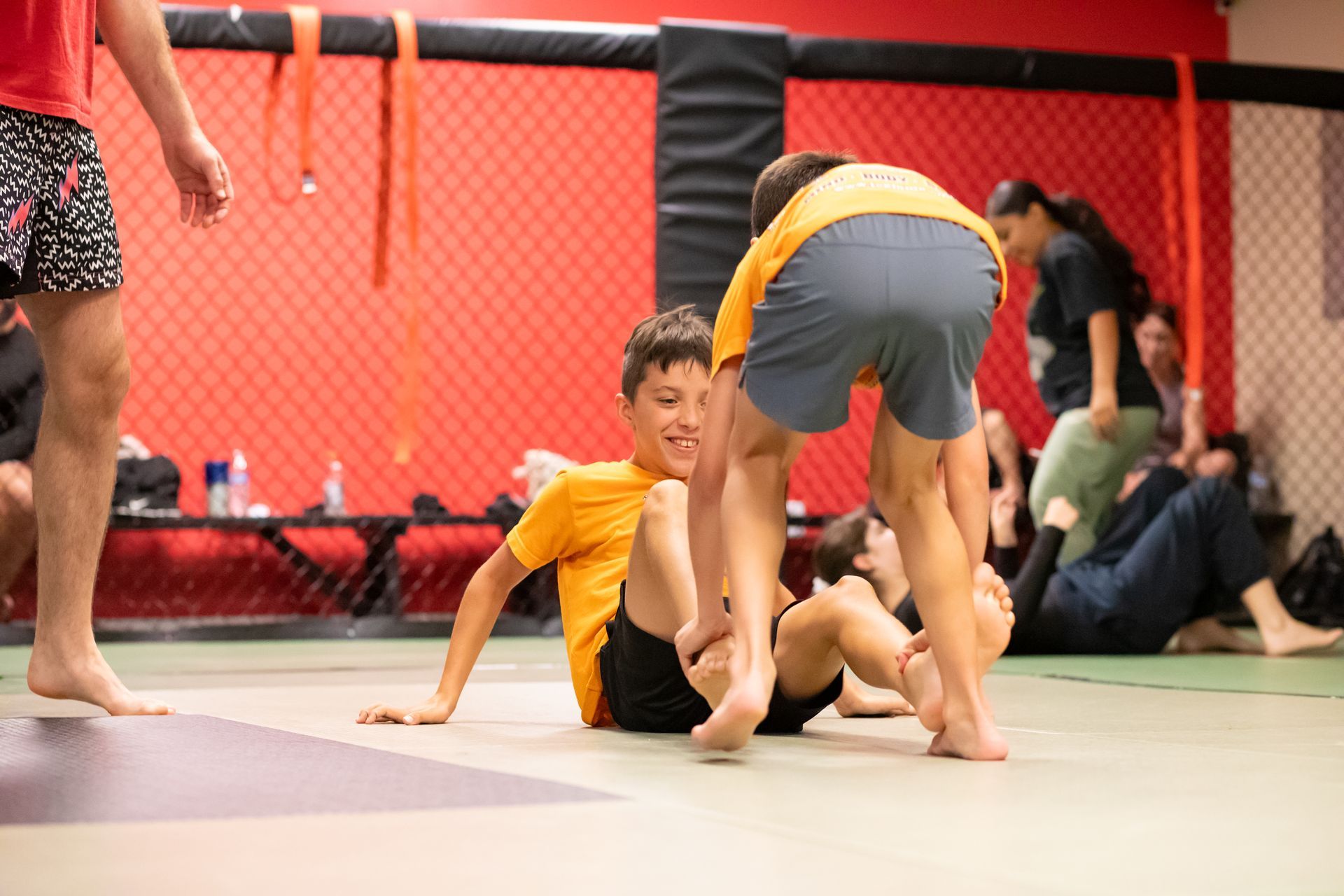
A good kids program should feel like play up front, while quietly building focus and confidence that shows up at home and at school.
When parents look for a kids activity, the checklist is usually pretty simple: it needs to be safe, it needs to burn energy, and it needs to keep your child interested longer than a week. Jiu-Jitsu checks those boxes in a way that surprises people, especially when you see how quickly kids start paying attention to details like posture, balance, and listening for instruction.
In our East Chambersburg classes, we treat kids training as a blend of movement games, skill-building, and character practice. The goal is not to turn your child into a fighter. The goal is to help your child become more focused, more capable, and more comfortable in their own skin, while still having a genuinely fun hour that feels like the best part of the day.
A big reason families choose Jiu-Jitsu in East Chambersburg right now is because kids are dealing with more distractions than ever. Screen time is the obvious one, but school pressure, social dynamics, and the general rush of life add up too. On the mats, we give kids a place where the rules are clear, progress is visible, and effort matters. That structure is calming, even for high-energy kids.
Why Jiu-Jitsu works so well for kids
Jiu-Jitsu is a grappling-based martial art built around leverage, positioning, and problem-solving. For kids, that means learning how to move their bodies with purpose, how to stay calm while working through a challenge, and how to keep trying when the answer is not immediate.
Because so much of Jiu-Jitsu is about control and technique, we can keep training playful without making it reckless. Kids learn to tap, reset, and keep going. That simple habit alone teaches self-control in a way lectures never do.
There is also something refreshingly honest about the mat. If you forget a step, you feel it. If you rush, you lose balance. If you breathe and slow down, the technique starts working. That feedback loop helps kids develop patience and attention, and it tends to carry over into school and home routines.
Focus and behavior gains you can actually notice
Parents often ask if training helps with school focus, listening, and emotional regulation. While every child is different, the overall trend is clear: structured martial arts practice supports attention and self-management.
A 2024 EJ Sport Journal survey reported that 96.4 percent of parents noticed improved confidence and life-skill transfer, 92.8 percent saw better commitment and mood, 87.5 percent reported reduced anxiety, and 78.6 percent observed enhanced concentration in kids training Brazilian Jiu-Jitsu. Those numbers line up with what we see in our program week after week: kids learn to follow steps, handle correction, and stay engaged even when they would rather wiggle, wander, or quit.
We build focus through small, repeatable habits:
- Lining up and starting class with a clear routine
- Listening for a short instruction, then applying it immediately
- Practicing a skill in short rounds, so attention resets before boredom hits
- Learning to be a good partner, which requires awareness and patience
Over time, kids start understanding that paying attention is not just something adults demand. It is something that helps them succeed.
Fitness that feels like fun, not a chore
Kids do not need another workout that feels like punishment. What kids need is movement that develops athleticism without making them dread it. Jiu-Jitsu delivers a surprising amount of conditioning because it uses full-body movement: pushing, pulling, crawling, bridging, shrimping, and balancing. It is functional, it is varied, and it keeps kids engaged.
This matters in a world where childhood obesity is a growing concern, with millions of U.S. children affected. Consistent training supports healthier body composition, coordination, and cardio fitness, but in a way kids will actually stick with. When class ends and your child is breathing hard and smiling, that is the sweet spot.
In practical terms, kids tend to improve:
- Core strength and posture from grappling movements
- Balance and coordination from footwork, base, and transitions
- Grip and upper-body endurance from controlled partner drills
- Stamina and recovery from short bursts of effort with breaks
Those improvements show up outside the academy too. Kids run a little smoother. They fall a little safer. They get up a little quicker.
Confidence without arrogance
We care a lot about the kind of confidence kids build. We want calm confidence, not swagger. The mat rewards humility because every partner can teach you something, and every round is a chance to learn.
That same 2024 survey data is echoed in other reports: around 75 percent confidence boost and a 70 percent increase in self-discipline are commonly observed outcomes for kids who train consistently. Confidence grows because progress is measurable. Your child learns a technique, practices it, and sees it work. That is earned confidence, and it tends to be stable.
We also see confidence grow socially. Partner drills require communication and respect. Kids learn to make eye contact, take turns, and handle winning and losing without melting down. It is not magic. It is repetition, structure, and coaching.
Anti-bullying benefits and real-world awareness
A question we hear often is, Will this help my child with bullying? We treat this carefully. Our priority is always safety, awareness, and smart decision-making. Physical skill is only one layer.
Research summaries often cite outcomes like 60 percent better danger awareness and about a 50 percent reduced bullying risk associated with consistent martial arts training. That makes sense because bullying dynamics shift when a child carries themselves differently. Posture improves. Eye contact improves. Panic decreases. Your child learns how to stay calm and create space, and that alone can defuse a lot.
In class, we emphasize:
- Boundary setting and assertive body language
- Escaping grabs and controlling distance
- Staying calm under pressure and using voice when appropriate
- Tapping early and respecting partners, so control becomes the habit
The goal is not fighting at school. The goal is knowing you can handle yourself, which changes how you move through the world.
What a kids class looks like in our East Chambersburg program
Parents want to know what actually happens on the mat. Our kids classes are structured, but not stiff. We keep things moving, because kids learn best when the pace is steady and the expectations are clear.
A typical class includes:
1. Warm-up movements that build coordination and body awareness
2. A short technique lesson taught in kid-friendly steps
3. Partner drilling with close coaching so kids stay safe and successful
4. A game or challenge that uses the skill in a playful way
5. A brief wrap-up focused on respect, effort, and progress
This mix keeps training engaging. It also gives kids multiple chances to “get it,” because learning does not always click the first time. Honestly, that is part of the lesson.
Age groups and how we scale training
Kids are not miniature adults, and we do not teach them like they are. Our program scales by age and developmental stage, so the skills stay appropriate and the experience stays positive.
Ages 4 to 6: coordination, confidence, and listening
At this stage, we keep techniques simple and focus on movement patterns, basic positions, and classroom habits. Success looks like following directions, staying on task, and learning to be a good partner.
Ages 7 to 10: skill-building and problem-solving
Kids start connecting sequences and understanding why positioning matters. We add more structured drilling and introduce controlled rounds that teach composure, not chaos.
Ages 11 to 13: resilience and leadership
Pre-teens benefit from the challenge and the structure. We emphasize goal-setting, consistency, and responsibility. This is where focus gains often become really noticeable.
Teens: confidence under pressure
Teens learn to think ahead, manage intensity, and deal with discomfort in a productive way. Jiu-Jitsu becomes a healthy outlet and a reliable routine, which is something many teens secretly want, even if they do not say it.
Safety: how we keep training controlled
Safety is not an afterthought for us. It is built into how we teach and how we manage the room. Jiu-Jitsu is contact-based, but it is also one of the most coachable martial arts because control and tapping are part of the culture.
We keep kids safe through:
- Close supervision and clear rules about intensity
- Technique-first instruction before any live practice
- Mat space awareness, so kids learn to move responsibly
- Partner pairing that keeps size and experience in mind
- A strong expectation of respect, including stopping immediately when asked
If you are wondering whether Jiu-Jitsu is safe and fun for young kids, the answer is yes when it is coached correctly. Our classes are built to be challenging without being chaotic.
How progress works: belts, goals, and motivation
Kids thrive on visible progress. Our belt system and skill milestones give kids something concrete to work toward, but we do not make it feel like a pressure cooker. We reward effort, consistency, and attitude, not just raw athletic ability.
You will usually notice progress in stages:
- The first few classes: comfort improves, nerves drop, routines become familiar
- Weeks 4 to 8: coordination improves, basic techniques start showing up naturally
- Around 12 weeks: better emotional regulation and calmer reactions become noticeable, which lines up with studies showing reduced emotional symptoms and hyperactivity after a consistent training period
The best part is that kids learn the real secret: improvement comes from showing up.
Family training and the bridge to adult classes
A lot of families love that training can become a shared activity instead of one more thing on the calendar. Kids train, parents talk with other parents, and over time many adults decide to step on the mat too.
If you are curious about Adult Jiu-Jitsu in East Chambersburg, we keep our adult classes beginner-friendly and structured, with clear coaching and a culture that respects learning pace. Parents often tell us it is nice to have an outlet that is challenging, practical, and social without being loud or performative.
Family participation also reinforces consistency. When your child sees you value training, it becomes normal, like brushing teeth or doing homework. Not always easy, but normal.
Take the Next Step
When you want something that builds real focus, real fitness, and real confidence, Jiu-Jitsu tends to deliver in a way that feels surprisingly natural for kids. Our program in East Chambersburg is designed to keep training safe, structured, and fun, so your child can grow without dreading practice.
If you are ready to explore what that looks like in person, Mason Dixon Jiu-Jitsu makes it simple to get started, see our approach up close, and find a routine that fits your family.
See firsthand what makes training at Mason Dixon Jiu-Jitsu special by joining a Jiu-Jitsu class today.