One good class can shift your whole week, because the right kind of challenge wakes up your body and settles your mind.
Life in East Chambersburg moves fast in a quiet kind of way: work, school, errands, family schedules, and the constant pull of screens. When you feel tired and scattered, it is tempting to assume you just need more willpower or more coffee. In our experience, most people actually need a better outlet, and Jiu-Jitsu is one of the most reliable ones we have seen.
Jiu-Jitsu gives you a place to use your brain and your body at the same time. It is physical, but it is also strategic, like human chess with real consequences if you stop paying attention. That combination is a big reason people tell us they leave class feeling energized, more focused, and strangely more connected to the people around them.
This is not just feel-good talk. Brazilian Jiu-Jitsu training is linked with neurochemical shifts that can change how your day feels: endorphins for stress reduction and energy, dopamine for motivation through skill mastery, and serotonin boosts that come from healthy social connection. Studies also report big changes in mood, confidence, anxiety reduction, and even executive function and sleep quality when people train consistently.
Why Jiu-Jitsu feels like an energy reset after a long day
Most workouts make you tired. A well-run Jiu-Jitsu class tends to make you feel used in a good way, like you finally burned off the mental noise that has been sitting in your shoulders all day. Part of that is intensity, but part of it is the way the training forces presence.
When you are drilling a technique, your attention narrows to grip placement, hip angle, timing, and breathing. When you are sparring, your mind has no space left for the email you forgot to answer or the argument you replayed in your head. You are here, on the mat, solving a moving puzzle.
From a science angle, that experience lines up with endorphin release. Endorphins are often described as the body’s natural feel-good chemicals, and they are strongly tied to exercise, stress reduction, and that post-training calm alertness many students talk about. You might finish class sweaty and tired, but your nervous system often feels more balanced than it did when you walked in.
We also see a practical energy benefit: as your conditioning improves, everyday life feels easier. Regular training supports cardiovascular health, strength, flexibility, and anaerobic capacity. Over time, stairs, yard work, long shifts, and busy weekends with kids take less out of you, which sounds small until it is your normal.
The “endorphin storm” effect and why it matters in East Chambersburg
People in East Chambersburg are juggling plenty, even if it does not always look dramatic from the outside. A demanding job, a long commute, caregiving, school obligations, and the general weight of “being on” can flatten your energy. We like Jiu-Jitsu because it does not just distract you, it gives your body a reason to change.
A lot of students tell us they sleep better on training days. That is not surprising, considering research connects consistent practice with improved sleep quality and mood. Better sleep is not a side perk, it is the foundation for better energy and patience the next day.
How Jiu-Jitsu builds focus that carries into work and school
If you have trouble focusing, you are not alone. Most people are overstimulated and under-recovered. We can feel busy all day and still not feel productive, which is an annoying combination.
Jiu-Jitsu trains focus in a way that is hard to fake. You cannot multi-task during a roll. You cannot scroll, half-listen, and still progress. You have to notice details and make decisions quickly, and you get immediate feedback. That feedback loop is one reason skill development feels addictive in a healthy way.
Research trends from 2021 to 2024 also point to brain health benefits, especially when you train two or more times per week. Consistent training supports neural connections tied to memory, problem-solving, mind-body awareness, and executive function like working memory and cognitive flexibility. That is a fancy way of saying you get better at staying calm, adapting, and choosing a smart option even when things are moving fast.
Dopamine and mastery: the focus you earn, not the focus you force
When you finally hit a clean technique you have been drilling, you can feel it. It is not just pride, it is a real motivation boost. That “I did it” moment is connected to dopamine, which plays a big role in learning, reward, and sustained effort.
We structure training so you can collect those wins often. Sometimes it is learning to frame properly from bottom. Sometimes it is escaping a bad spot without panicking. Sometimes it is simply breathing instead of holding your breath through the whole round. Those are all focus skills, and they show up elsewhere too.
Students frequently report improved confidence and reduced anxiety, and the numbers in recent studies are striking: around 87.6 percent report improved confidence, 87.5 percent report reduced anxiety, and 96.9 percent report better mood. Focus is part of that picture because anxiety and distraction often feed each other.
Connection: why the mat creates a “real community” feeling
A surprising benefit of Jiu-Jitsu in East Chambersburg is how quickly people start feeling like they belong. There is something about learning hard things with other people that turns strangers into teammates.
You will drill with partners, learn names, share small victories, and laugh at the awkward moments that happen when you are learning a new movement pattern. Over time, the room starts feeling like a support system. Research ties social connection to serotonin, which helps regulate mood and emotional balance. That matters, especially when modern life can feel isolating even when you are surrounded by people.
We keep our training environment friendly, structured, and respectful. That makes it easier to show up consistently, and consistency is where the deeper benefits live.
What connection looks like in a normal week
Connection is not always big speeches and dramatic transformations. Usually it is smaller than that:
- A training partner who notices you look tired and helps you drill at a steady pace
- A coach who remembers what you are working on and gives you one detail that unlocks it
- Seeing familiar faces after a stressful day and realizing you do not have to carry everything alone
That kind of community support can feel like a family network, and people often do better in life when they have one.
What happens in a typical class, and why it works
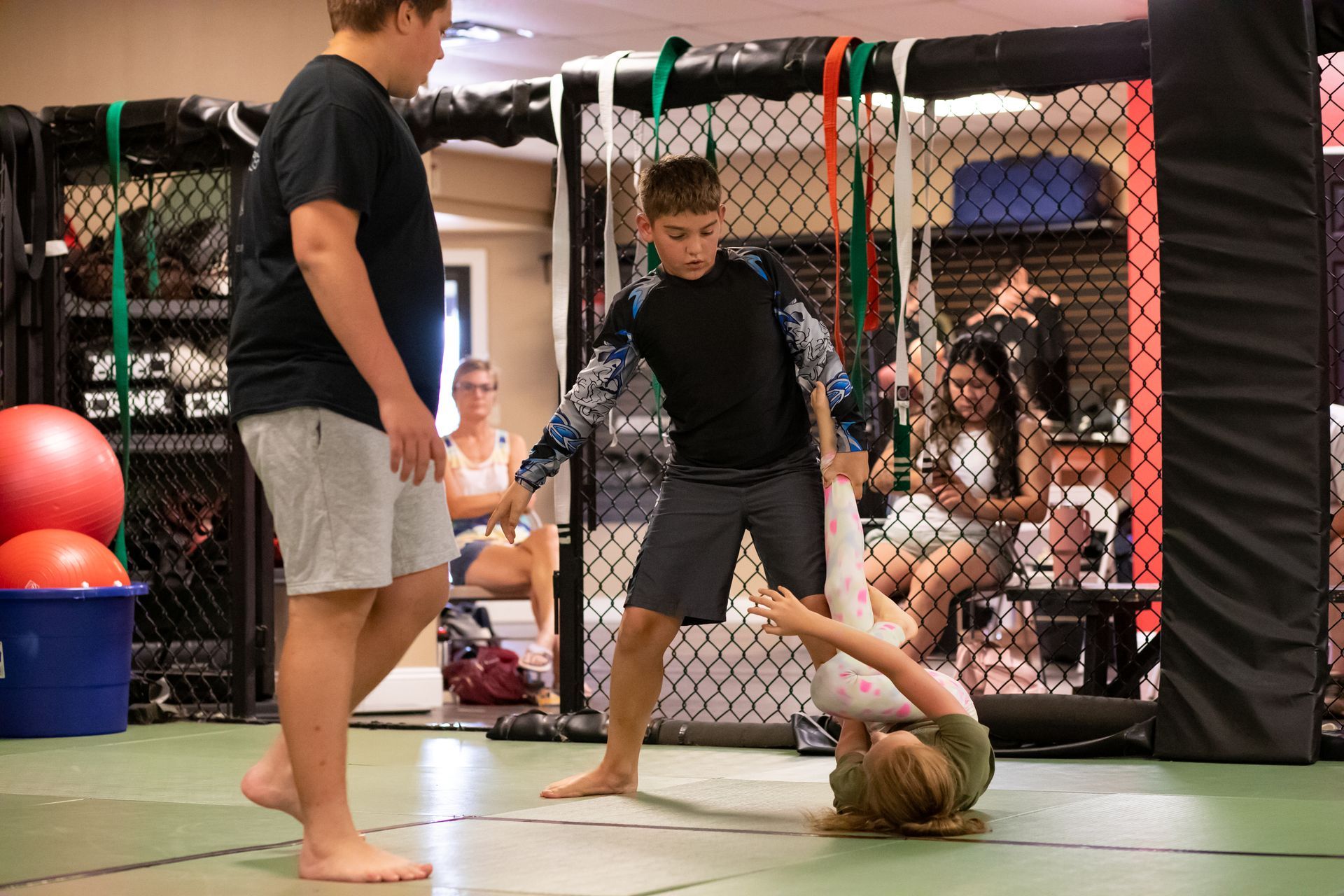
Most beginners worry that Jiu-Jitsu is going to be chaotic or intimidating. It does not have to be. We run classes with a clear flow so you can learn safely and steadily.
A typical class includes instruction, drilling, and controlled sparring. Drilling builds skill, sparring teaches timing and decision-making, and both build conditioning. We emphasize technique over brute strength, especially early on, because good Jiu-Jitsu is efficient.
Here is what we focus on so your training stays productive:
- Clear technical themes so you understand what you are practicing and why
- Progressive resistance so you can build confidence without being overwhelmed
- Safety habits like tapping early and communicating with partners
- Conditioning that happens naturally through movement, not punishment workouts
- A culture of learning where questions are welcome and mistakes are normal
This approach is also why people of different ages and fitness levels can train together without it turning into chaos. You can work hard and still feel taken care of.
Youth Martial Arts in East Chambersburg: confidence, discipline, and calmer screens
Kids today are dealing with a lot, even when life looks comfortable. School pressure, social stress, and screen habits can create short attention spans and big emotions. Youth Martial Arts in East Chambersburg should do more than “tire kids out.” It should teach them how to regulate themselves.
Jiu-Jitsu is excellent for youth development because it teaches control before power. Kids learn boundaries, body awareness, and how to stay composed when something feels hard. That transfers into better behavior at home, better listening at school, and more confidence in social situations.
Research and surveys consistently show positive mental health and confidence outcomes for practitioners, and families often notice life skills improving alongside the physical skills. Belt progression also gives kids a simple, healthy structure for goal-setting. It is visible progress that rewards effort, not just talent.
What we want your child to gain from training
Our youth training is about building capable, grounded kids, not little tough guys. We coach skills that show up off the mat:
- Self-discipline: showing up, listening, and finishing what was started
- Calm under pressure: breathing, problem-solving, and not melting down when frustrated
- Respectful confidence: knowing what you can do without needing to prove it
- Social growth: working with partners, taking feedback, and learning teamwork
- Physical literacy: balance, coordination, and safe movement patterns
Parents often tell us the biggest shift is that their child seems more settled. Not perfect, not robotic, just steadier.
Stress relief that is practical, not abstract
A lot of “stress management” advice is vague. Jiu-Jitsu is not vague. It teaches you how to stay functional when pressure is real and close.
When you are pinned, you learn to relax enough to think. When you are tired, you learn to keep moving without panicking. When you make a mistake, you learn to reset quickly instead of spiraling. That is emotional regulation in a very practical form.
This is also why veterans and first responders often respond well to grappling training in broader research: the combination of physical exertion, skill learning, and social belonging can reduce PTSD symptoms over time. We cannot promise outcomes, but we can say the training environment supports resilience, and the structure helps people rebuild a sense of control.
How often you should train to feel the mental benefits
Consistency beats intensity. Training once in a while can be fun, but it is the steady rhythm that changes your baseline energy and focus.
Based on current research trends and what we see day to day, two classes per week is a strong starting point for mental health and brain benefits. Three classes per week tends to accelerate progress for many people, as long as recovery and sleep stay solid.
If you want a simple plan you can actually follow, we recommend this:
1. Start with two classes per week for the first month so your body adapts
2. Track two things only: sleep quality and stress level the next day
3. Add a third class if your recovery is good and your schedule allows it
4. Stay technique-focused rather than trying to “win” every round
5. Reassess after eight weeks, because that is when many people notice a real shift
The goal is not to be sore all the time. The goal is to feel better at life, more often.
Safety, comfort, and what beginners usually worry about
Starting something new can feel awkward. That is normal. We make beginner onboarding simple, and we keep safety standards high.
Jiu-Jitsu is a contact sport, so we coach smart habits from day one: tapping early, controlling speed, and communicating. We also pair people thoughtfully so you can learn without feeling thrown into the deep end.
If you are worried about being “in shape enough,” you do not need to be. Training is how you get in shape. If you are worried about feeling out of place, most beginners are. We keep the environment welcoming and structured so you can focus on learning.
Take the Next Step
If you want more energy that is not jittery, focus that is not forced, and connection that feels real, we built our Jiu-Jitsu experience in East Chambersburg around those outcomes. The training is challenging, but it is the good kind of challenging, the kind that leaves you clearer afterward.
When you are ready, we would love to help you start in a way that fits your schedule and your goals. That is exactly what we do every day at Mason Dixon Jiu-Jitsu, and it is why so many local families stick with Mason Dixon Jiu-Jitsu once they find their rhythm.
Put these techniques into live practice by joining a Jiu-Jitsu class at Mason Dixon Jiu-Jitsu.