A few simple grappling fundamentals can sharpen your attention, toughen your body, and steady your nerves faster than most people expect.
If you are looking for a way to feel more focused at work or school, stronger in everyday movement, and calmer under pressure, Jiu-Jitsu is one of the most practical paths we teach. It is physical, yes, but the real hook is how quickly it changes the way you think when something gets uncomfortable. You learn to solve problems in real time, not in theory.
We also see how fast confidence can show up when training is structured well. Research on grappling and related training environments reports that 87.6% of adult practitioners notice improved confidence, 87.5% report reduced anxiety, and 96.9% report better mood, with youth showing 96.4% confidence gains reported by parents. Numbers are helpful, but what matters day to day is simpler: you walk out of class feeling like your brain got rinsed clean.
In East Chambersburg, that matters. Life is busy, stress is normal, and plenty of people want fitness that feels engaging instead of repetitive. Our classes are built so you can start right where you are, learn a few core movements, and feel tangible progress within weeks, not months.
Why Jiu-Jitsu improves focus faster than you think
Focus is not only about willpower. It is about having a clear task, immediate feedback, and consequences that are safe but real. On the mat, if your attention drifts for even a second, you feel it. Then you correct it. That loop builds a kind of practical concentration that carries into the rest of your day.
We coach you to treat every position like a small puzzle: Where is the pressure coming from, where is the space, what is the next safest step? That problem solving under pressure is a big reason Jiu-Jitsu is being discussed more and more in mental wellness conversations. Recent trends point to confidence gains outpacing more traditional martial arts by a notable margin, likely because grappling forces constant adaptation, not memorization.
A surprising bonus is that rolling often creates a flow state. Your mind cannot multitask the way it does during the day. You are present, breathing, moving, responding. For many students, that is immediate stress relief, like your nervous system finally gets a straightforward job.
The fast track: 5 beginner moves that translate into real life
You do not need a huge technique library to get meaningful results. We like to start with a handful of fundamentals that give you leverage, mobility, and decision-making reps. Here are five moves we return to constantly because they build everyday focus, strength, and confidence quickly.
1. The Shrimp Escape (hip escape) for focus and problem solving
The shrimp escape looks simple, but it teaches a critical habit: create space before you try to “win.” That is true in grappling and in daily stress. When you are pinned, your first job is not to panic. It is to make a little room, then build from there.
Mechanically, you are learning to coordinate hips, shoulders, and frames while keeping breathing steady. Mentally, you are practicing a calm checklist:
- Protect your neck and posture
- Frame to manage pressure
- Move your hips, not just your arms
- Reset to a safer position
That sequence is one of the fastest ways we help beginners feel competent in Jiu-Jitsu, because it turns “stuck” into “working a plan.”
2. Side control escape for confidence under discomfort
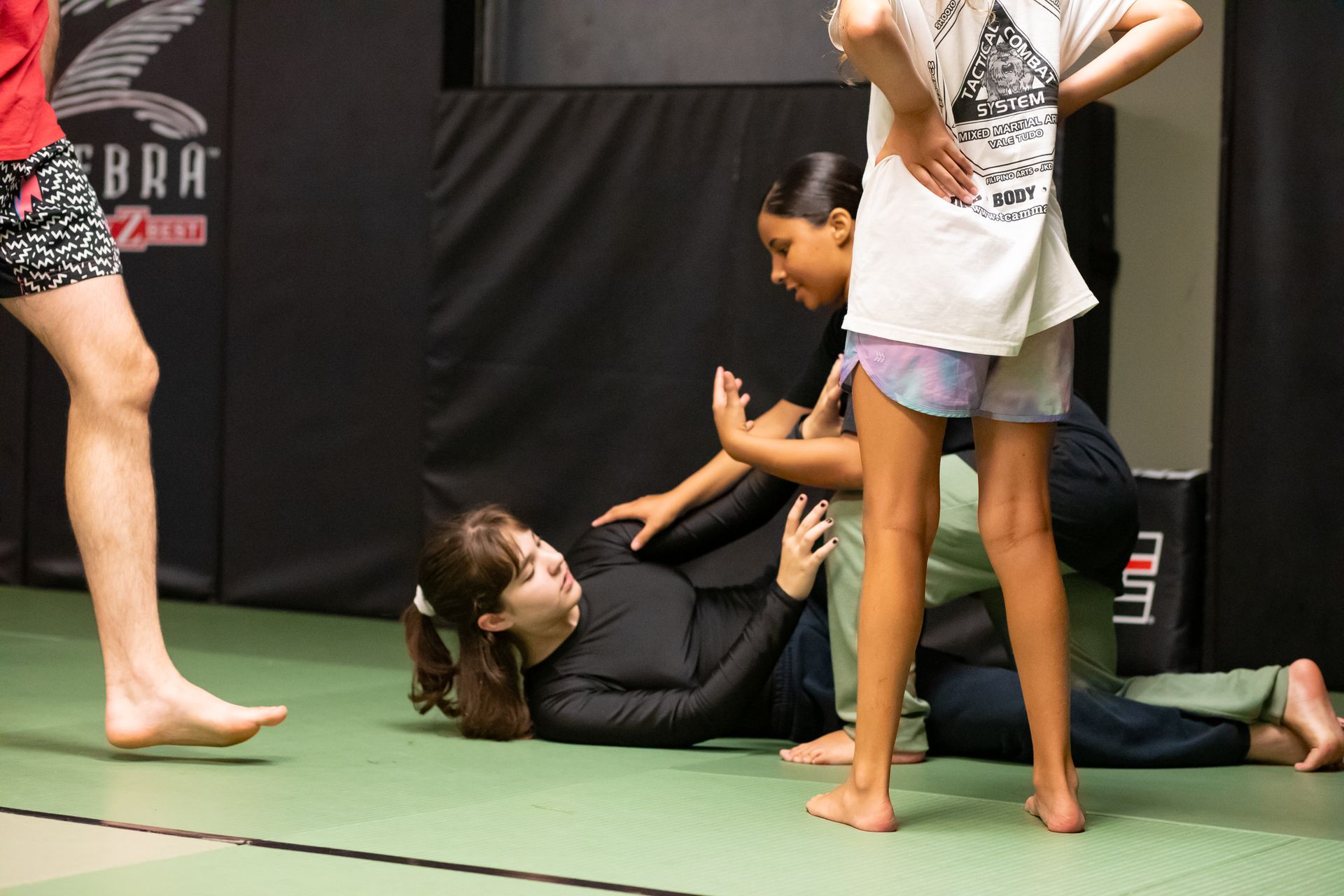
Side control is uncomfortable. That is the point. Learning to survive and escape teaches composure in a situation that feels heavy and urgent. We teach you to treat discomfort as information, not as a signal to quit.
This is where confidence grows fast because you get proof. You start by getting pinned. Then you learn a frame. Then you recover a guard or get to your knees. Those are milestones, and milestones stack. Many adults tell us this has an immediate effect outside the gym: meetings feel less intimidating, stressful conversations feel more manageable, and you stop catastrophizing when things get tight.
From a physical standpoint, side control escapes build functional strength through your trunk, shoulders, and hips, because you are connecting your whole body to move one inch at a time.
3. The Bridge and Roll (upa) for full-body power
The bridge and roll is one of the best examples of leverage-based power. You are not “bench pressing” someone off you. You are using timing, posture disruption, and a strong hip drive.
This movement builds:
- Hip extension strength that helps with running, lifting, and getting up off the floor
- Neck and upper back awareness (you learn what alignment feels like)
- The confidence to commit to a technique decisively
In day-to-day life, that translates into more athletic movement. You feel sturdier. Your body learns to fire as a unit instead of in isolated pieces.
4. Closed guard posture and control for calm decision-making
Closed guard is where many people first learn that Jiu-Jitsu is not only about strength. It is about managing distance, grips, posture, and angles. We teach top players to stay safe and balanced, and bottom players to control posture and set up simple attacks.
Why does that matter for focus? Because you cannot rush here. If you try to force things, you burn energy and make mistakes. You learn to slow down, collect information, and choose one option at a time. That is the same mental skill you use when you are overwhelmed at work: reduce variables, stabilize, then act.
5. A basic guard pass for confidence and forward progress
Passing the guard is where beginners often feel stuck, because it looks like a lot is happening. Our approach is to give you a simple passing structure so you always have a next step: posture, base, pressure, then progress.
Passing builds confidence quickly because it is measurable. You either improved your position or you did not. And when you do pass, you feel it in your whole body. It is a clean win that reinforces the idea that consistent reps create real change.
How these moves build everyday strength without chasing “gym numbers”
We like weights. We also know plenty of people do not want another program that feels like math. Grappling strength is different because it is coordinated: you are pulling, pushing, posting, framing, rotating, and breathing under load.
Our drills and live rounds develop practical strength in ways you notice outside the gym:
- Carrying and lifting feels easier because your grip and trunk are stronger
- Your balance improves because your hips and feet learn to cooperate
- Your shoulders and back build endurance from frames and posture work
- Your flexibility increases naturally because you spend time in varied ranges safely
For many adults, this matters more than a one-rep max. You feel capable in your own body again, and that is a kind of confidence that shows up everywhere.
Why confidence comes quickly in Jiu-Jitsu (and why it sticks)
Confidence is not a motivational poster. It is a pattern of evidence your brain trusts. In training, you get that evidence constantly: you try something, it fails, you adjust, it works. That is also why anxiety often drops for regular students, with studies showing 87.5% reporting reduced anxiety and improved mood overall.
We also normalize failure as part of learning. If you only do activities where you already feel “good,” your confidence stays fragile. On the mat, you get comfortable being a beginner, and that is a powerful life skill. You learn that tapping is not losing; it is collecting data and staying safe.
For youth, the confidence shift can be even more noticeable. Parents commonly report improvements in self-control and willingness to try hard things, with data showing 96.4% youth confidence gains reported by parents. That makes Youth Martial Arts in East Chambersburg feel less like an extracurricular and more like a foundation for school, friendships, and healthy boundaries.
What to expect in our classes in East Chambersburg
We keep training structured and welcoming, especially for beginners. You will warm up with movement patterns that support the techniques of the day, then we teach a small slice of Jiu-Jitsu you can actually remember. After that, you drill with a partner and build comfort step by step.
Live sparring (rolling) is introduced in a controlled way. We do not throw you into chaos and hope it works out. You will learn how to tap, how to control intensity, and how to keep training partners safe. That safety-first culture is what makes progress possible.
If your main goal is fast results, consistency matters more than intensity. We typically recommend training twice per week to build momentum without burning out. It is enough exposure for your body to adapt and for your mind to start recognizing patterns, which is where focus and confidence really accelerate.
A simple 4-week plan for faster focus, strength, and confidence
If you like a clear target, here is a straightforward way to approach your first month. We use this kind of roadmap in the program because it keeps progress honest and realistic.
1. Week 1: Learn how to breathe, frame, and move your hips (shrimp and bridge basics)
2. Week 2: Add one escape from bottom and one control from top, then drill slowly
3. Week 3: Start positional sparring from a single scenario so you can think clearly
4. Week 4: Roll short rounds, track small wins, and repeat your core moves until they feel natural
By the end of four weeks, most students can name their go-to escape, maintain posture more reliably, and stay calmer during resistance. That is the beginning of real Jiu-Jitsu in East Chambersburg: not just knowing techniques, but being able to use them when you are tired.
Take the Next Step
If you want fast, tangible gains in attention, functional strength, and steady confidence, our approach at Mason Dixon Jiu-Jitsu is built around fundamentals that translate directly into everyday life. You will learn how to stay calm in bad positions, solve problems under pressure, and build a body that feels more capable week after week.
Whether you are looking for Jiu-Jitsu as an adult stress reset or you are exploring Youth Martial Arts in East Chambersburg for your child, we will help you start safely, train consistently, and measure progress in ways that actually matter off the mat at Mason Dixon Jiu-Jitsu.
Commit to steady progress and structured development at Mason Dixon Jiu-Jitsu.