This is a subtitle for your new post
Jiu-Jitsu gives you a repeatable way to feel sharper, steadier, and more capable in daily life.
If you are looking for a training routine that does more than “burn calories,” Jiu-Jitsu is worth a serious look. We see adults walk in carrying the same challenges East Chambersburg life brings: long work shifts, mental fatigue, constant noise from phones, and the feeling that energy runs out faster than it should. The good news is that the right kind of training can change that, and not just physically.
What makes Jiu-Jitsu unique is that it builds your engine and your composure at the same time. Research around Brazilian Jiu-Jitsu (BJJ) connects consistent training with improved mood, reduced anxiety, stronger self-control, and higher confidence, and those benefits tend to grow with experience. In one set of adult survey results, 87.6% reported increased confidence, 87.5% reported reduced anxiety, 81.3% reported better mental flexibility (a big part of focus), and 96.9% reported an improved mood. We use that same big-picture idea in our classes: build skills, build calm, and let the results show up everywhere else.
Why Jiu-Jitsu feels different from “just working out”
Most fitness plans are linear: lift the weight, run the miles, follow the timer, go home. Jiu-Jitsu is interactive. Your brain has to stay engaged because every round is a live problem to solve. Your body works hard, but your mind is learning how to stay steady under pressure, which is exactly what busy adults tend to crave.
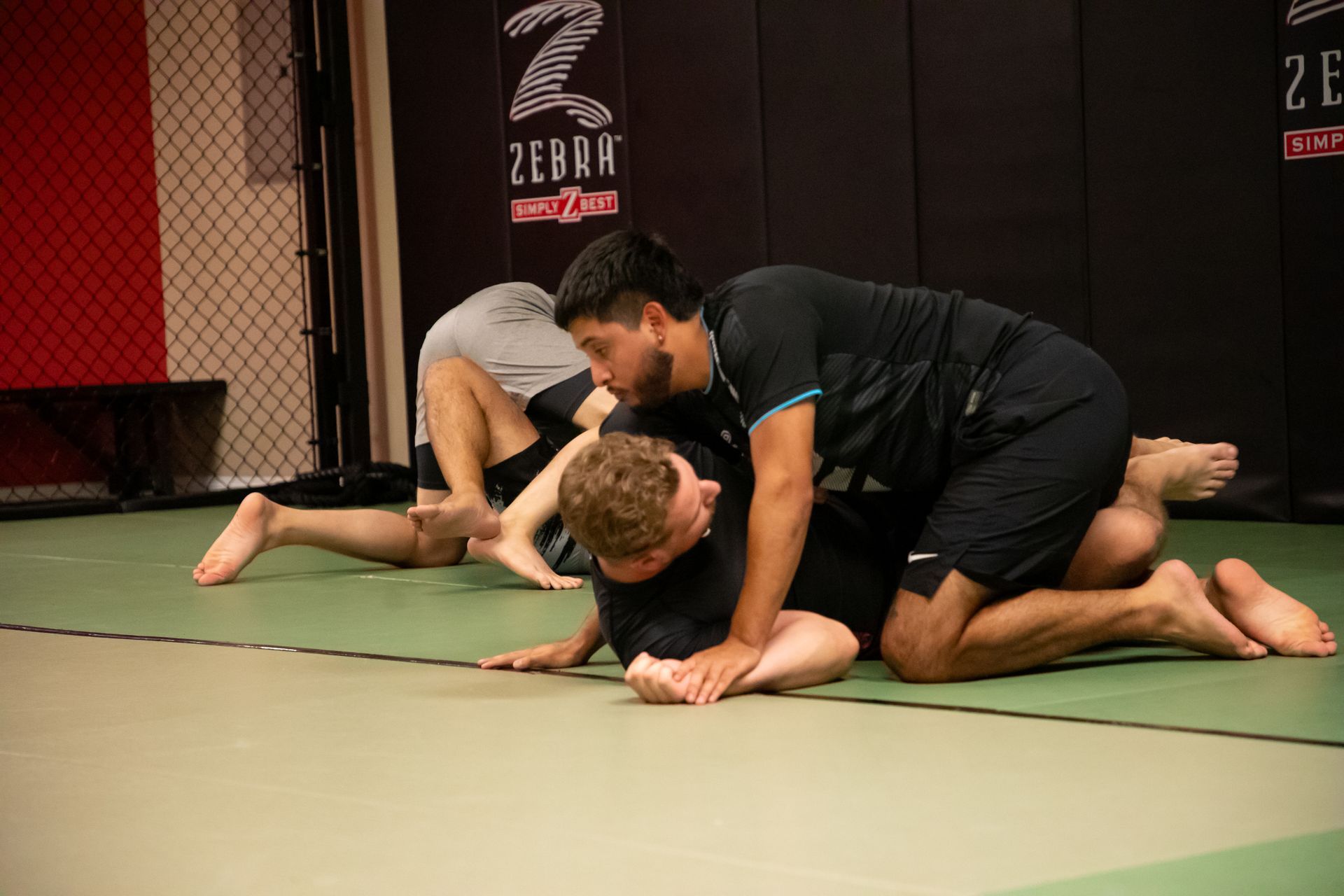
In practical terms, you train technique, balance, leverage, timing, and decision-making while somebody is actively resisting. That resistance is the point. It teaches you how to adapt without panicking, and it gives you real feedback fast. Over time, you stop wasting energy in both training and real life, because you learn what matters and what does not.
We also structure the program so you can build consistency, not just intensity. That matters for energy and focus. A plan you can repeat for months is better than a “perfect” plan you quit in two weeks.
Energy: how training teaches you to stop leaking fuel
When people say they want more energy, what they often mean is, “I want to get through my day without feeling drained.” Jiu-Jitsu helps on two levels. First, it improves conditioning and movement efficiency. Second, it teaches you to relax while working, which is surprisingly rare.
On the mats, new students often hold their breath, tense their shoulders, and try to muscle everything. That works for about 30 seconds. Then the energy crash hits. We coach you out of that pattern. You learn to breathe, frame, and move with intention. That is where “energy conservation under pressure” becomes a skill, not a motivational quote.
Here is what that can look like in real life: you notice your stress response sooner, you unclench faster, and you make cleaner decisions instead of rushing. For adults juggling jobs, families, and unpredictable schedules, that energy efficiency is a quiet superpower.
Simple training habits that support better day-to-day energy
- Train 2 to 3 times per week so your body adapts without feeling constantly “wrecked”
- Focus on relaxed breathing during drills, especially when positions feel uncomfortable
- Prioritize sleep and hydration on training days because recovery is where energy builds
- Keep your ego out of rounds so you do not turn every spar into an all-out sprint
- Track how you feel the next morning, not just how hard the class felt at night
Focus: why Jiu-Jitsu sharpens attention instead of scattering it
Focus is not just the ability to concentrate when everything is quiet. Real focus is staying present when something is hard, fast, and stressful. Jiu-Jitsu forces that kind of attention, because the moment your mind wanders, you get immediate consequences: your posture breaks, your balance goes, or you give up a better position.
We design training so you get lots of “small decisions” over and over. Where do your hands go. Which direction do you turn. When do you slow down. When do you commit. That constant decision-making builds mental flexibility. It is not theory, it is repetition.
Adults often tell us the biggest surprise is how calm their mind feels after class. Even if your body is tired, the mental clutter gets quieter. That lines up with the mood and anxiety reductions reported in adult BJJ research, where large majorities note improved mood and lower anxiety along with stronger confidence.
What “better focus” looks like after a few months
You might notice you can sit through a meeting without checking your phone as much. You might get home and actually finish a task instead of bouncing between five half-started ones. You might handle conflict with a steadier voice. Those are not magical effects. That is training your nervous system to stay engaged and solve problems without spiraling.
Confidence: earned, not hyped up
Confidence in Jiu-Jitsu is not built by pretending you are tough. It is built by doing difficult things in a controlled environment, then realizing you can handle more than you thought. That is why the confidence numbers in adult surveys are so high. When 87.6% of adults report increased confidence, it is not because every day is easy. It is because progress is measurable.
In our adult classes, confidence grows in a few predictable stages. At first, confidence is simply showing up and not quitting. Then it becomes the ability to remember a technique under stress. Later, it becomes composure: you can be in a bad position and still think clearly.
That confidence carries over into everyday life in East Chambersburg. People feel more capable walking to their car at night. People feel more grounded at work. People feel less rattled by stressful conversations. You are still you, but you are harder to knock off center.
The community effect: why you feel better faster when you belong
One of the most underrated benefits of Jiu-Jitsu is the training room culture when it is done right. In one study set, 100% of participants reported stronger community and respect. That is not a small detail. Community is a mental health multiplier.
We take that seriously because adults do not just need another place to “work out.” You need a place where you can show up as you are, train hard, learn safely, and leave feeling better about your week. The room should feel welcoming, but not soft. Supportive, but not chaotic. When that balance is there, people stick with training long enough for the deeper benefits to show up.
What Adult Jiu-Jitsu in East Chambersburg looks like week to week
Adult training should fit real life. People here work early shifts, late shifts, rotating schedules, and everything in between. We build our class structure so you can join in, learn, and progress even if you are not training every single day.
A typical class has a few parts: movement or warm-up, technical instruction, drilling, and live training (sparring) that is scaled to your level. If you are brand new, we help you learn how to move safely and how to train with control. If you have experience, we keep you challenged with details that matter.
We also talk openly about pacing. You do not need to “win practice” to benefit. You need consistent rounds where you learn, breathe, and improve.
How progress works: a clear path without guesswork
One reason Jiu-Jitsu in East Chambersburg has become such a powerful option for adult fitness is that progress is built into the training. You can feel it month by month. You stop getting tired as fast. You recover quicker. You recognize patterns sooner. The brain is learning as much as the body.
Here is the basic progression we aim for in our adult program:
1. Weeks 1 to 4: learn how to move, breathe, and stay safe while picking up core positions
2. Weeks 5 to 8: connect techniques into simple sequences and start problem-solving in live rounds
3. Weeks 9 to 12: develop composure under pressure, improve timing, and notice real changes in focus
4. Months 4 and beyond: build resilience, confidence, and consistency that transfers into work and home
Research trends from recent years also point to progression-based benefits, where more experienced practitioners show greater mental toughness, self-efficacy, and emotional stability. We see the same pattern when students stay consistent.
Common concerns we hear, and how we handle them
Adults have good reasons to hesitate before starting something new. Time, injury worries, being “out of shape,” or not wanting to feel awkward in a room full of experienced people. We get it, and we coach around it.
If you are worried about fitness, you do not need to get in shape before joining. Training is how you get in shape, and we scale the pace. If you are worried about age, plenty of adults start later and do great, because Jiu-Jitsu rewards technique and patience. If you are worried about safety, we emphasize control, good training partners, and smart intensity.
And if you are just nervous, that is normal too. Most people are. The confidence comes after you begin.
Ready to Begin
If you want more energy that lasts past lunchtime, focus that holds up under stress, and confidence that feels real, Jiu-Jitsu gives you a practical path. At Mason Dixon Jiu-Jitsu, we build that path through structured training, a welcoming room, and coaching that helps you progress without burning out.
If you are specifically searching for Adult Jiu-Jitsu in East Chambersburg, our goal is to make starting simple and sustainable. Use the website to check the class schedule, choose a good first day to come in, and let your first few weeks be about learning the basics and feeling the difference.
If you’re curious about Jiu-Jitsu, join a class at Mason Dixon Jiu-Jitsu and learn from the ground up.